



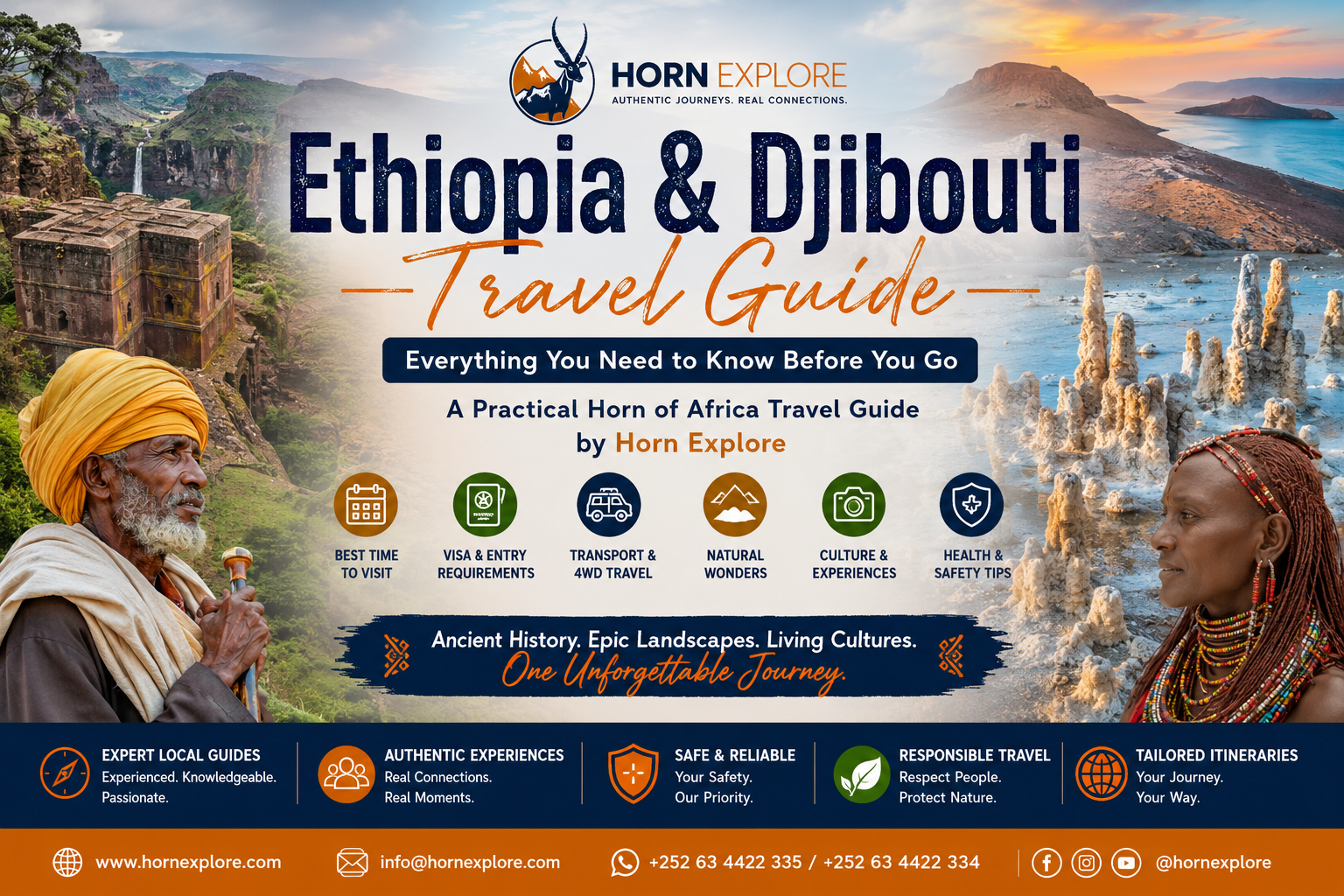

Ethiopia & Djibouti Travel Guide: Everything You Need to Know Before You Go
A Practical Horn of Africa Travel Guide by Horn Explore
Ethiopia and Djibouti are two of the most remarkable destinations in the Horn of Africa—but they are not destinations to approach as an ordinary holiday.
From Ethiopia’s ancient highlands, rock-hewn churches, volcanic landscapes and exceptional wildlife to Djibouti’s salt lakes, desert terrain, coral coastlines and Afar culture, the region offers a rare combination of history, adventure, geology and living traditions.
For first-time visitors, however, preparation is essential.
Distances can be significant, road conditions can vary widely, temperatures can be extreme, infrastructure outside major cities can be limited, and some of the most rewarding locations are accessible only with experienced local operators, suitable vehicles and careful logistical planning.
This guide brings together the key practical considerations for travellers planning an Ethiopia, Djibouti or combined Horn of Africa expedition.
Prepared and independently rewritten for Horn Explore.
Why Travel to Ethiopia and Djibouti?
Few regions offer such dramatic contrasts within relatively short distances.
In Ethiopia, travellers move from cool mountain plateaus to deep valleys, volcanic deserts, historic cities and tropical lowlands. The country combines extraordinary landscapes with a long and complex history, distinctive religious traditions and remarkable cultural diversity.
Djibouti offers a completely different experience. Its landscape is defined by volcanic formations, salt lakes, desert plains, rugged mountains and the waters of the Gulf of Tadjoura.
The result is a journey that can include:
- Ancient history
- Archaeology
- Wildlife
- Mountain trekking
- Desert exploration
- Volcanoes and geothermal landscapes
- Traditional cultures
- Food and coffee experiences
- Marine activities
- Photography
- Off-road expeditions
Ethiopia and Djibouti are destinations where dramatic landscapes, history, wildlife and cultural traditions converge in a single region.
1. When Is the Best Time to Visit?
There is no single ideal season for the entire region, as Ethiopia and Djibouti vary significantly in elevation, climate and terrain.
Your optimal travel period depends on your route and intended activities.
Ethiopia
For many classic Ethiopian itineraries, the period from October to March is particularly favourable.
Following the rainy season, landscapes are often lush, skies are clearer, and trekking conditions in many highland areas are generally good.
January is also a peak cultural period due to major religious celebrations, offering exceptional cultural experiences.
The high season typically runs from January to March, while October to December often provides greener scenery, clearer visibility and fewer visitors.
Djibouti
Djibouti is strongly influenced by heat.
The cooler months are significantly more comfortable for desert and outdoor expeditions, particularly for visits to:
- Lac Assal
- Lac Abbé
- Ghoubet Bay
- Ardoukoba
- Goda Mountains
- Tadjoura
- Remote desert regions
Important planning principle
Do not select travel dates based solely on flight prices.
Choose your timing according to the route and conditions.
A highland trek, a Danakil expedition and a Djibouti desert journey each have distinct optimal seasons.
2. Money: Cash Remains Essential
Travellers should not assume that international credit cards will be widely accepted.
While major cities and higher-end hotels may accept cards, cash remains essential in most areas outside urban centres.
US dollars are commonly recommended as a reliable backup currency, particularly in remote regions where card facilities are limited.
Ethiopia
The local currency is the Ethiopian birr (ETB).
Djibouti
The local currency is the Djibouti franc (DJF/DFr).
Practical recommendation
For expeditions beyond major cities:
Carry a sufficient emergency reserve of clean, usable foreign currency.
Do not rely entirely on ATMs.
Before departure, confirm with your operator:
- Currency availability
- ATM access along your route
- Card acceptance
- Fuel and remote logistics
- Emergency cash requirements
3. Visa and Entry Requirements
Visa requirements vary depending on:
- Nationality
- Point of entry
- Type of itinerary
- Current immigration regulations
- Whether travel is independent or organised
Ethiopia and Djibouti operate different visa systems, and overland travel may involve additional requirements compared to air entry.
Do not rely on outdated visa information.
Regulations and fees can change frequently.
Always confirm current requirements with official embassies, immigration authorities or your authorised local operator before travel.
For organised expeditions
A professional operator can assist with:
- Invitation letters
- Entry coordination
- Regional permits
- Border logistics
- Local registration
- Site permissions
- Transport arrangements
For remote expeditions, these arrangements should be completed prior to arrival, not at the border.
4. Getting Around Ethiopia
Ethiopia is a large and geographically diverse country, and travel times are often longer than maps suggest.
Delays can result from:
- Mountain terrain
- Road conditions
- Traffic
- Weather
- Construction
- Remote geography
- Long distances between services
Domestic flights
Domestic flights are often the most efficient way to cover long distances, particularly when combining multiple regions in one itinerary.
4WD expeditions
For remote areas, a well-equipped 4WD vehicle with an experienced driver is often essential.
A private vehicle provides:
- Greater flexibility
- Improved access to remote areas
- More control over stops
- Enhanced comfort
- Better photography opportunities
- Access to non-standard routes
Some national parks and remote regions require 4WD access.
5. Getting Around Djibouti
Although Djibouti is smaller than Ethiopia, travel can still be logistically demanding.
Many of the country’s most impressive landscapes are located far from Djibouti City and require extended overland travel.
Public transport connects major towns, but services are limited in remote areas. Off-road travel typically requires suitable 4WD vehicles.
For serious exploration, a professionally managed expedition vehicle is usually the most practical option.
Why 4WD is essential
A Djibouti expedition may involve:
- Desert tracks
- Volcanic terrain
- Rough roads
- Salt plains
- Remote camps
- Long distances without services
Experienced logistical support is therefore more important than simply selecting the lowest-cost transport option.
6. Lac Assal: Djibouti’s Salt Lake
Lac Assal is one of Djibouti’s most iconic natural landmarks.
Situated well below sea level, the lake is surrounded by volcanic formations and extensive salt deposits.
Its striking geology makes it one of the most visually distinctive landscapes in the region.
For photographers, the contrast of:
white salt, dark volcanic rock, blue sky and arid mountains
creates a highly dramatic setting.
7. Lac Abbé: A Surreal Landscape
Lac Abbé is one of Djibouti’s most extraordinary environments.
It is known for its limestone and mineral chimneys rising from a stark, otherworldly landscape.
These formations are the result of long-term geothermal and volcanic activity.
At sunrise and sunset, the area becomes particularly atmospheric, making it a highlight for photographers and expedition travellers.
Horn Explore recommendation
Lac Abbé should not be treated as a brief stop.
Adequate time should be allocated to fully experience the changing light and atmosphere.
8. The Danakil Depression
The Danakil Depression is one of the most extreme environments in the Horn of Africa.
It is characterised by:
- Volcanic landscapes
- Sulphur formations
- Extreme heat
- Salt plains
- Geothermal activity
- Afar communities
- Remote expedition routes
This is not conventional tourism.
Due to its harsh conditions and limited infrastructure, travel must be carefully organised.
Expedition principle
The Danakil should be treated as a structured expedition, not a casual excursion.
Proper logistics, experienced local teams, suitable vehicles, water supplies, communication systems and appropriate timing are essential.
9. Wildlife in Ethiopia and Djibouti
Wildlife in the Horn of Africa differs significantly from traditional safari destinations.
Ethiopia is particularly notable for its endemic species, including:
- Ethiopian wolves
- Gelada monkeys
- Walia ibex
- Hyenas
- Diverse birdlife
- Antelope species
- Highland and lowland fauna
The Bale Mountains are especially important for Ethiopian wolves, while the Simien Mountains are known for geladas and Walia ibex.
Djibouti adds a marine dimension, including seasonal whale shark encounters in the Gulf of Tadjoura.
10. Whale Sharks in Djibouti
Djibouti offers one of the region’s most remarkable marine experiences: encounters with whale sharks.
These large but gentle animals can be observed seasonally in the Gulf of Tadjoura.
For wildlife and photography enthusiasts, this can complement desert and volcanic expeditions.
However, all wildlife encounters are natural and cannot be guaranteed.
No responsible operator can guarantee sightings of wild animals.
11. Ethiopia’s Historic and Cultural Heritage
Ethiopia is not only a landscape destination but also a country of exceptional historical significance.
Key sites include:
Lalibela
Famous for its rock-hewn churches carved directly into stone.
Aksum
An ancient centre of Ethiopian civilisation.
Gonder
Known for its imperial castles and historic architecture.
Harar
A walled historic city with unique cultural traditions and markets.
Tigray
Renowned for its dramatic rock-hewn churches in mountainous settings.
12. Ethiopia’s Living Cultures
Ethiopia’s cultural diversity is one of its defining characteristics.
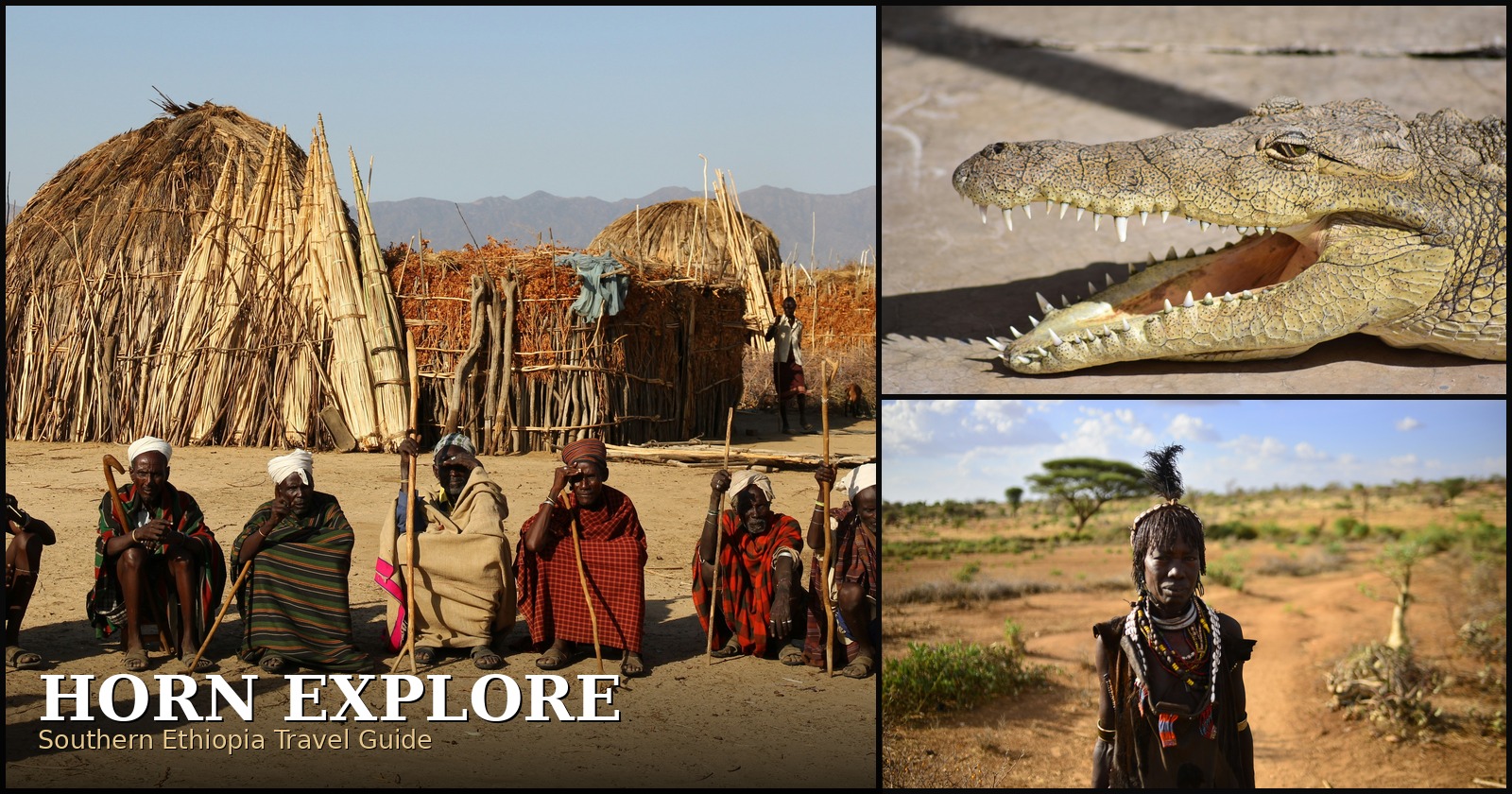
The Lower Omo Valley, in particular, is home to numerous communities with distinct languages, traditions and social structures, including the Mursi, Karo and Hamer peoples.
Responsible travel guidelines
When visiting communities:
- Always request permission before photographing people
- Respect religious and cultural sites
- Follow guidance from local experts
- Avoid intrusive behaviour
- Support local artisans where appropriate
- Be sensitive during ceremonies
Responsible tourism ensures a more meaningful experience for both visitors and host communities.
13. Food and Ethiopian Coffee
Food is an integral part of the Ethiopian travel experience.
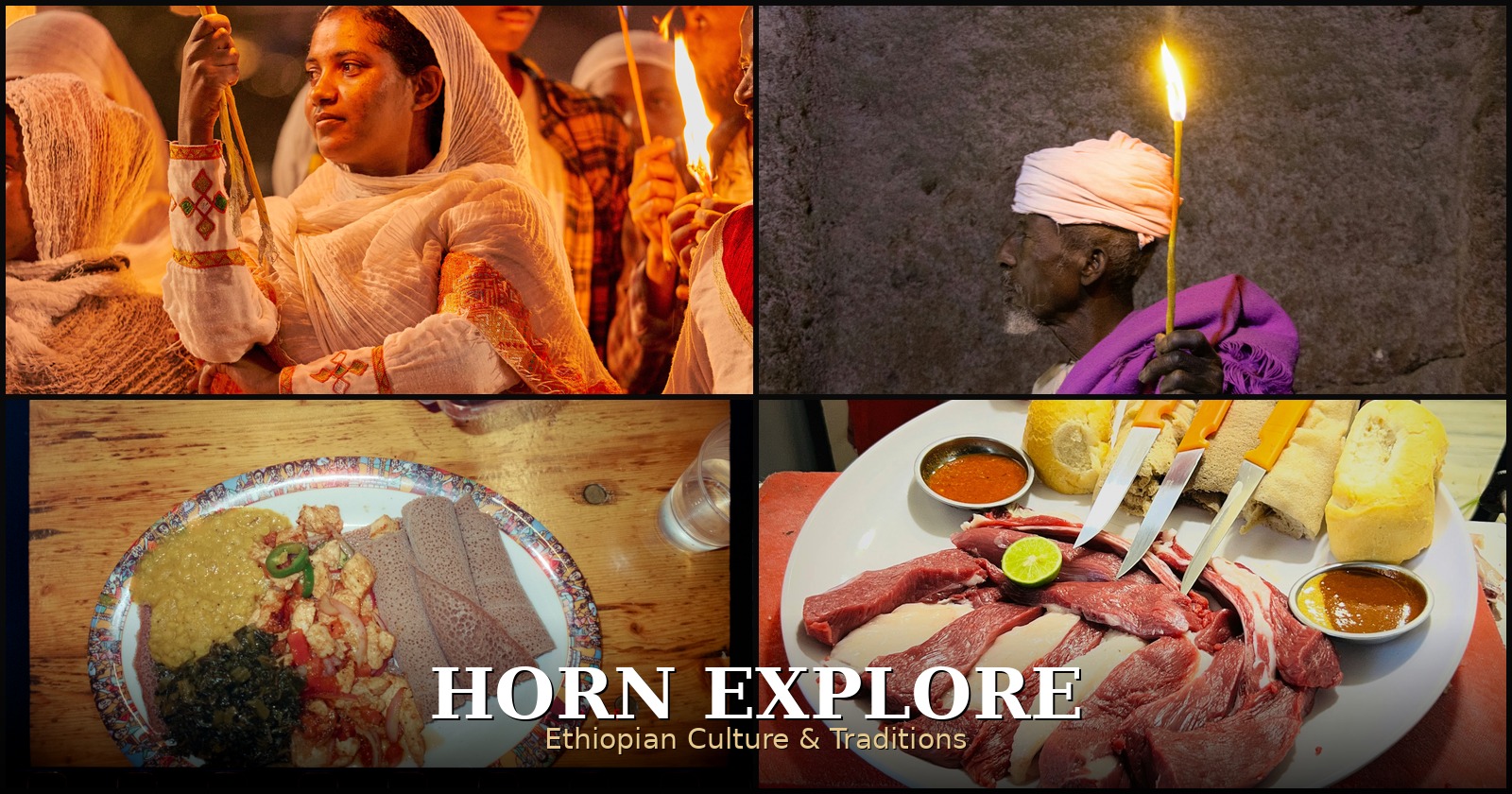
Cuisine is typically communal and based on shared dishes such as:
- Injera
- Wat
- Shiro
- Tibs
- Vegetables
- Legumes
- Spices
Meals are often served on a shared platter, making dining a cultural experience as well as a culinary one.
Ethiopian coffee ceremonies are also a highlight and represent an important cultural tradition.
14. Language
Ethiopia is highly linguistically diverse, with languages including:
- Amharic
- Oromo
- Tigrinya
- Somali
- Afar
- Sidama
- Gurage
- Welaita
- Hadiya
- English (in tourism and business contexts)
In Djibouti, French, Arabic, Somali and Afar are widely used.
Traveller tip
Learning a few basic greetings can significantly enhance interactions.
15. Mobile Phones and Internet
Connectivity varies significantly between urban and remote areas.
While Addis Ababa and Djibouti City generally offer reliable communication, coverage in rural, mountainous and desert regions can be limited or unavailable.
Before travel
Download:
- Offline maps
- Itinerary details
- Accommodation information
- Emergency contacts
- Copies of key documents
Do not assume mobile connectivity will be available throughout remote expeditions.
16. Health and Medical Preparation
Health preparation should be completed well in advance of travel.
Medical facilities are more developed in major cities, while remote areas have limited access to healthcare.
Before departure, consult a qualified travel health professional regarding:
- Vaccinations
- Malaria prevention
- Food and water safety
- Altitude considerations
- Heat exposure
- Personal medication
- First-aid preparation
Water and hydration
In remote regions, only treated or sealed drinking water should be used.
Hydration is particularly important in Djibouti due to extreme heat.
17. Heat: A Serious Consideration
The Horn of Africa can experience extreme temperatures, particularly in:
- Djibouti
- Danakil Depression
- Afar region
- Desert environments
- Salt lakes
- Volcanic areas
Heat exhaustion can occur quickly and without warning.
Essential precautions
- Carry sufficient water
- Use electrolytes
- Wear sun protection
- Use a hat and sunglasses
- Wear lightweight clothing
- Apply high-SPF sunscreen
- Avoid strenuous activity during peak heat
18. Safety and Situational Awareness
Travellers should review current travel advisories before departure, as conditions may change.
Standard precautions include:
- Securing valuables
- Avoiding display of cash
- Staying alert in crowded areas
- Protecting documents
- Following local guidance
- Using reputable operators
In remote regions, the quality of logistical planning is particularly important.
19. The Value of a Local Tour Operator
Many destinations in Ethiopia and Djibouti are not suited to independent travel.
Remote areas may involve:
- Long 4WD journeys
- Limited accommodation
- Permit requirements
- Difficult terrain
- Security coordination
- Limited communications
- Extreme environmental conditions
A professional operator provides not only transport, but also:
route planning, permits, timing, cultural understanding, logistics and safety management.
20. What to Pack
Packing requirements depend on itinerary type, but for most expeditions, the following are recommended:
- Passport and travel documents
- Copies of key documents
- Travel insurance details
- Personal medication
- First-aid kit
- Reusable water bottle
- Sun protection
- Hat and sunglasses
- Lightweight clothing
- Warm layer for highlands
- Comfortable walking shoes
- Headlamp
- Power bank
- Offline maps
- Camera equipment
- Insect repellent
- Basic toiletries
Additional equipment may be required for remote expeditions.
21. Responsible Photography
Ethiopia and Djibouti offer exceptional photographic opportunities, but ethical practice is essential.
Core principle:
Always ask permission and respect personal dignity.
This is especially important when photographing:
- Children
- Religious ceremonies
- Local communities
- Military or government sites
- Border areas
- Sacred locations
22. How Long Should You Stay?
Short trip
3–5 days
Focused visit to a single region.
One-week itinerary
6–8 days
Allows a more comprehensive experience.
Extended expedition
10–14+ days
Suitable for multi-region travel across Ethiopia and Djibouti.
Itineraries should be based on realistic travel times, not just distances.
23. Ethiopia + Djibouti: A Combined Expedition
A combined itinerary offers one of the most diverse travel experiences in the region.
A typical route may include:
Addis Ababa → Eastern Ethiopia → Djibouti City → Lac Assal → Ghoubet Bay → Lac Abbé → Goda Mountains → Tadjoura
This journey transitions through:
highlands → historic cities → desert → volcanic landscapes → salt lakes → mountains → coastline
24. The Horn Explore Approach
At Horn Explore, we design journeys that go beyond standard tourism.
Our approach is based on:
Local expertise
Working with experienced local guides and communities.
Authentic experiences
Focusing on meaningful cultural and natural encounters.
Expedition planning
Careful coordination of routes, logistics and timing.
Responsible travel
Respect for people, culture and environment.
Tailored itineraries
Flexible journeys designed around traveller interests and timeframes.
Final Thoughts
Ethiopia and Djibouti reward travellers who arrive well prepared.
These are destinations where each day can bring a completely different environment—from ancient cities to volcanic deserts, from highland plateaus to salt lakes and coastal waters.
Wildlife, culture, history and landscapes combine to create a region of exceptional diversity.
However, the Horn of Africa is not simply a collection of attractions. It is a region defined by distance, complexity, extreme environments and living traditions.
Travel thoughtfully. Travel responsibly. Travel with experienced local knowledge.
And above all:
Travel to experience the Horn of Africa—not just to visit it..




Comment (0)
Leave A Comment: