



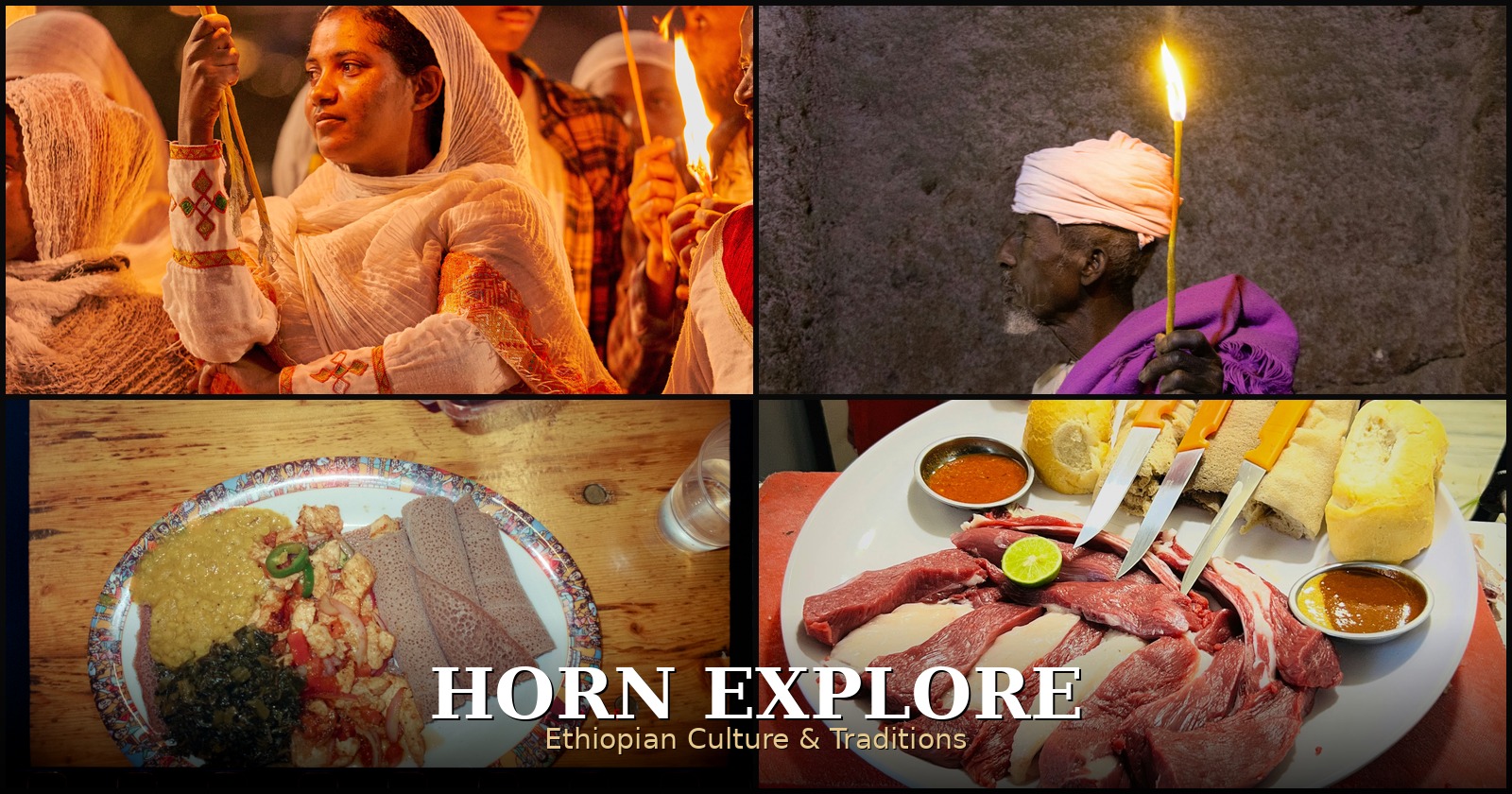

Ethiopia is one of only two African nations never colonised, and that unbroken history shows in almost everything about the place — its own calendar, its own script, its own cuisine, and a cultural identity that owes very little to the outside world. Understanding Ethiopian culture means understanding a country that has always looked inward for its answers, and built something remarkably rich in the process.
At Horn Explore, we think culture is the real reason people fall in love with this region — more than any single landmark. Here's our guide to the ideas, beliefs, and everyday rituals that shape life in Ethiopia today.
The Legend That Explains Everything: Solomon and Sheba
To understand Ethiopian identity, you first have to understand a story — one that Ethiopians consider closer to history than myth. According to the Kebra Negast, Ethiopia's national epic, the Queen of Sheba (known locally as Makeda) travelled to Jerusalem around the 10th century BC to visit King Solomon. Their meeting, the legend says, produced a son, Menelik I, who would go on to found Ethiopia's royal line — a line of succession Ethiopian emperors claimed descent from for the next three thousand years, right up until Haile Selassie was deposed in 1974.
The story doesn't stop there. Tradition holds that when the grown Menelik later visited his father in Jerusalem, he returned home with the Ark of the Covenant itself, smuggled out among his belongings. To this day, many Ethiopians believe the actual Ark rests in a chapel in Aksum, guarded by a single monk who is the only person permitted to see it. Whether or not any of it is historically verifiable, the legend is genuinely foundational — it's the backbone of Ethiopian Orthodox identity, the reason Aksum is treated as a holy city, and a story nearly every Ethiopian can recite without hesitation.
Faith at the Centre of Daily Life
Religion in Ethiopia isn't a private matter reserved for Sundays or Fridays — it's woven into everyday conversation, greetings, and decision-making. Roughly two out of every five Ethiopians are Orthodox Christian and about a third are Muslim, with Orthodox Christianity historically dominant in the highlands and Islam more prevalent in the eastern, southern, and western lowlands — though both faiths have significant communities in cities across the country, including Addis Ababa.
Ethiopian Orthodox Christianity has an unusually old pedigree: Ethiopia became only the second nation on Earth, after Armenia, to adopt Christianity as a state religion, tracing back to the 4th century AD. The faith carries strong echoes of Judaism — dietary restrictions, methods of animal slaughter, and even the traditional round shape of Ethiopian churches are widely believed to reflect Hebraic roots, alongside older Semitic and pre-Christian influences that never fully disappeared.
Ethiopian Orthodox churches are famous for their walls, which are almost never left bare. Vivid murals cover them floor to ceiling, depicting a distinctive cast of saints, angels, and folkloric figures unique to Ethiopian Christian tradition — some solemn, some wildly imaginative, and often surprising to first-time visitors expecting more restrained religious art.
A Society Built Around Family and Community
Family life in Ethiopia tends to be close-knit by design. It's common for adult children to remain in the family home until marriage, and even after starting a household of their own, extended families typically stay closely connected — sharing land, labour, and support across generations in a way that's increasingly rare in fast-urbanising societies elsewhere.
Hospitality customs reflect this same communal instinct. Greetings are unhurried and genuinely important — a proper Ethiopian handshake is soft rather than firm, sometimes accompanied by a light shoulder bump between close friends, and offered to everyone in a room, children included. Rushing a greeting, or skipping it altogether, can come across as more than just impolite.
The Ritual of Coffee
Ethiopia is widely credited as the birthplace of coffee, and nowhere is that legacy more visible than in the traditional coffee ceremony — a ritual, not just a beverage. Green beans are roasted by hand over hot coals right in front of guests, filling the room with smoke and aroma, then ground and brewed in a clay pot called a jebena. The first of three rounds is considered the strongest and most honoured; declining an invitation to a coffee ceremony, especially the first round, is rarely done lightly.
The ceremony can take the better part of an hour, and that's the point — it's a deliberate pause built into the day for conversation, hospitality, and connection, often performed for guests as a mark of welcome and respect.
Injera: More Than Just Bread
No discussion of Ethiopian culture is complete without injera, the spongy, slightly sour flatbread made from fermented teff — a tiny, nutrient-dense grain that grows almost exclusively in Ethiopia's highlands. Injera isn't served alongside a meal so much as it is the meal: a large platter is lined with it, various stews and vegetable dishes are spooned on top, and diners tear off pieces to scoop everything up, using only their right hand.
Quality varies a great deal, and Ethiopians take it seriously — the best injera is pale, evenly spongy, and made from pure teff flour, while lower grades (sometimes cut with other grains) tend to be darker and coarser. First impressions of the tangy, fermented flavour are mixed among visitors, but it's an acquired taste that tends to grow on people fast, especially paired with rich, spiced stews like doro wat.
Music and Dance as Everyday Language
Music runs deep in Ethiopian culture, and it isn't confined to concert halls — restaurants, weddings, and street celebrations regularly feature live performance. Traditional entertainment includes the azmari, a wandering minstrel tradition dating back centuries, who performs improvised, often witty verses accompanied by the masenko, a single-stringed fiddle. Azmari culture historically thrived both among ordinary travellers on the road and, in a more refined form, within royal courts.
Dance is just as central, and nearly every one of Ethiopia's more than 80 ethnic groups has its own distinctive style. The best known nationally is the iskista, a striking dance built around rapid, controlled shoulder movements while the hips and legs remain still — deceptively difficult to master, and a highlight of any traditional celebration. In the Omo Valley, dance styles shift entirely, often built around jumping and leaping, while in the highlands the fukara, a boasting dance once tied to warrior culture, is still performed at festivals today, complete with mock displays of defiance.
Ethiopia's contemporary music scene has also produced major stars, from Aster Aweke — sometimes called Africa's answer to Aretha Franklin — to Ejigayehu "Gigi" Shibabaw, whose voice reached international audiences through Hollywood film. It's a scene that blends traditional pentatonic scales with modern production, giving Ethiopian pop and R&B a sound distinct from almost anywhere else on the continent.
An Ancient Written Tradition
Ethiopia's literary history stretches back further than most people expect. Inscriptions in Ge'ez, an ancient South Semitic language, date back roughly 2,500 years, and Ge'ez became the language of scholarship and scripture during the Aksumite era — it's the language the Bible was first translated into locally, centuries before Amharic became Ethiopia's dominant tongue. Even after Ge'ez died out as a spoken language, it remained the language of Ethiopian Orthodox liturgy, much as Latin persisted in the Catholic Church long after people stopped speaking it day to day.
The 13th and 14th centuries are generally regarded as the golden age of Ge'ez literature, the period most historians believe produced the Kebra Negast itself. Ethiopia's own alphabet — technically an abugida, where each character represents a consonant-vowel pair — remains in active daily use today, one of the few indigenous writing systems in Africa still in widespread modern use.
Why This Matters for Your Trip
None of this is background trivia — it shapes what you'll actually experience on the ground. It's why priests will insist on telling you a church's founding legend in full detail rather than a quick summary. It's why a coffee ceremony offered to you isn't a tourist add-on, but a genuine social custom you're being invited into. And it's why a shared injera platter, eaten by hand with new acquaintances, tends to leave a stronger impression on travellers than almost any landmark.
At Horn Explore, we build our itineraries around giving travellers real access to this — church visits guided by people who grew up with these stories, home-hosted coffee ceremonies, and time built in to simply sit and share a meal rather than rush to the next stop.
Talk to Horn Explore about experiencing Ethiopian culture firsthand →
Horn Explore — Authentic Horn of Africa Tours & Expeditions.
A note on sourcing
This guide was written independently by the Horn Explore team, drawing on general and historical knowledge about Ethiopian culture, religion, and tradition. It is not a summary or reproduction of any single guidebook or publication






Comment (0)
Leave A Comment: